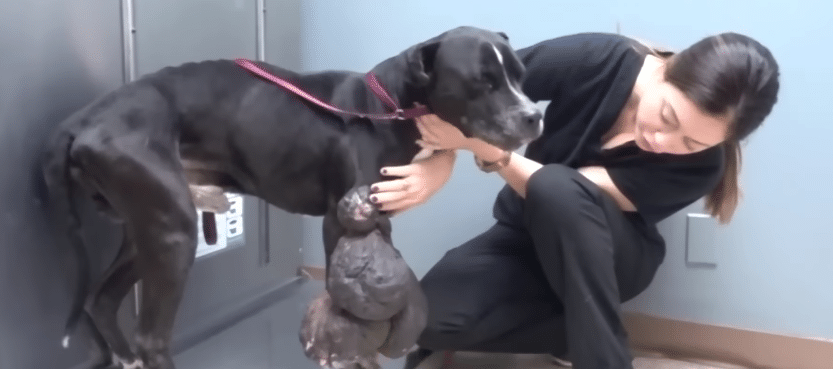
When rescuers first noticed Shadow walking along a quiet street, his condition immediately raised concern. The black-coated stray appeared extremely thin and weak, but another problem made movement especially difficult: a very large mass was attached to his right front leg.
According to the rescue account, the growth weighed more than 11 pounds, or approximately five kilograms. For an already underweight dog, carrying that additional weight made every step challenging.
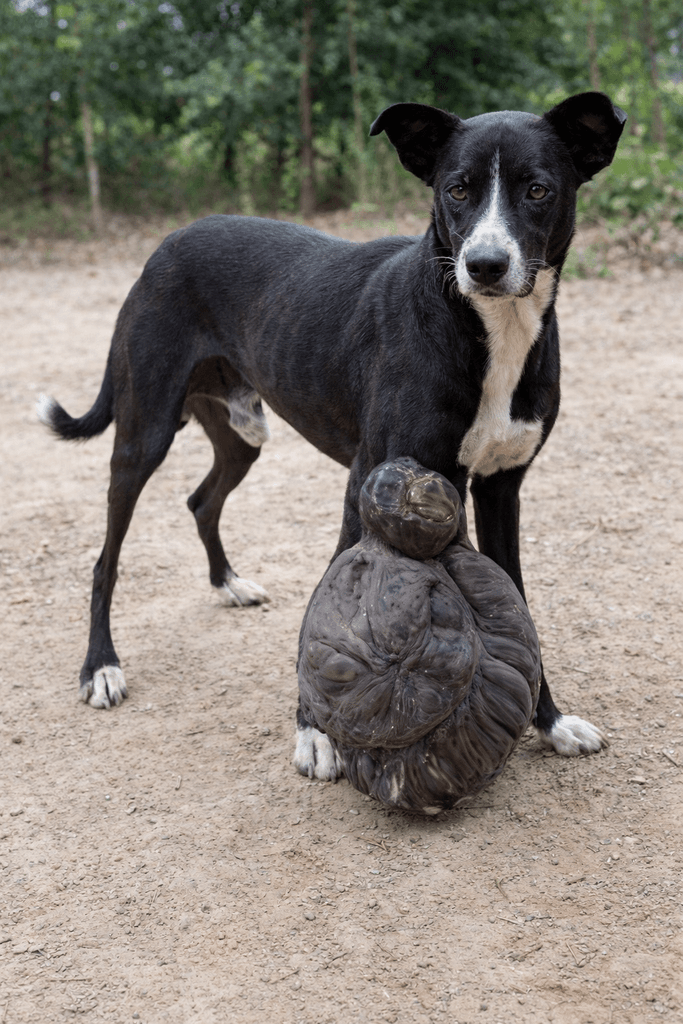
Yet Shadow remained surprisingly receptive to the people approaching him. He reportedly wagged his tail and gently licked a rescuer’s hand. That small interaction became the beginning of a much larger journey involving veterinary surgery, nutritional rehabilitation, heartworm treatment, and weeks of patient recovery.
Video He Dragged a 12-Pound Tumor With Every Step But Shadow Never Stopped Wagging His Tail
A Difficult Life on the Street
Nobody could determine Shadow’s complete history simply by looking at him. What rescuers could see was a dog who urgently needed professional attention.
His low body condition suggested that nutrition would be an important part of his recovery. The large mass on his front leg also required diagnostic evaluation before anyone could determine what treatment might be possible.
This distinction matters. Not every visible lump is cancerous, and appearance alone cannot establish whether a growth is benign or malignant. Veterinarians may rely on examinations, imaging, laboratory analysis, and tissue testing to reach an appropriate diagnosis.
For Shadow, reaching a veterinary hospital was therefore the essential first step.
Veterinarians Evaluate More Than the Visible Problem
The large growth naturally attracted attention, but Shadow’s medical evaluation reportedly identified another significant concern: heartworm disease.
Heartworms are parasites transmitted through infected mosquitoes. Dogs can develop serious health complications when an infection progresses, which is why routine prevention is so important.
Treatment depends on the individual animal’s condition and should be managed by a veterinarian.
Shadow’s overall health made planning particularly important. His medical team needed to consider his body condition, heartworm status, the size and location of the growth, and whether he could safely undergo surgery.
According to the rescue account, veterinarians initially considered the possibility that his affected leg might need to be removed.
Further examination, however, offered another possibility.
Could Surgeons Save Shadow’s Leg?
Once veterinarians could assess the mass more thoroughly, the team reportedly determined that attempting to preserve Shadow’s leg was possible.
It would not be a simple operation.
Large masses can involve surrounding tissues and important blood vessels, making surgical planning critical. The goal is not merely to remove visible tissue but to perform the procedure as safely as possible while preserving healthy structures whenever medically appropriate.
The rescue account states that Shadow’s surgeons decided to attempt removal of the growth while saving his leg.
That decision began a long and delicate operation.
A Major Weight Is Finally Removed
Shadow’s veterinary team reportedly worked for hours to separate and remove the mass.
The procedure required careful attention because of its size and relationship with surrounding structures. Eventually, the team succeeded in removing it while preserving the affected limb.
According to the account, the removed mass weighed close to 12 pounds.
For Shadow, that meant an enormous physical burden was suddenly gone.
But surgery was not the end of his treatment.
His body still needed to recover from the procedure, his nutritional condition required improvement, and his heartworm infection needed appropriate veterinary management.
In many rescue stories, surgery provides the dramatic turning point. In reality, postoperative care often determines what happens next.
Recovery Requires More Than Rest
After the operation, Shadow’s leg was bandaged and monitored while the surgical area healed.
Caregivers also focused on rebuilding his overall condition.
An underweight dog recovering from a major procedure needs balanced nutrition, but increasing food intake should be approached thoughtfully. Veterinarians can determine suitable calorie levels and monitor weight gain based on the dog’s medical status.
Protein, essential fats, vitamins, minerals, hydration, and adequate calories all contribute to maintaining and rebuilding healthy tissue.
Rest matters too.
During early recovery, excessive activity can interfere with healing. As the veterinary team permits, controlled movement can gradually become part of rehabilitation.
Shadow’s progress therefore depended on finding the right balance between rest and activity.
Laboratory Results Bring Encouraging News
Removing a mass does not automatically reveal exactly what it was.
Veterinary teams can submit tissue for laboratory analysis, where specialists examine it to determine its characteristics.
According to Shadow’s rescue story, testing found that his tumor was benign.
That result provided encouraging news for everyone involved in his care.
Still, follow-up remained important. Veterinary teams may recommend monitoring after the removal of a growth depending on its type, location, surgical findings, and laboratory results.
Shadow could now continue concentrating on his wider recovery, including rebuilding his physical condition and receiving treatment for the heartworm infection identified during his initial evaluation.
Why Heartworm Prevention Matters
Shadow’s case also provides a useful reminder about preventive veterinary care.
Heartworm disease is much easier to prevent than to manage after a dog becomes infected.
Mosquitoes transmit heartworm larvae between animals, which means even dogs that spend substantial time indoors may potentially encounter mosquitoes in regions where heartworm occurs.
Veterinarians can recommend preventive products based on a dog’s age, location, lifestyle, and medical history. Routine testing may also be advised according to local veterinary guidelines.
Owners should never begin or change heartworm medication without professional guidance, particularly when a dog’s infection status is unknown.
Preventive care may seem ordinary compared with emergency surgery, but those ordinary measures often protect pets from much larger medical challenges later.
Small Improvements Add Up
As the weeks passed, Shadow reportedly began looking and behaving increasingly different from the dog first discovered on the street.
His body condition improved.
His coat appeared healthier.
Without the enormous mass affecting his front leg, movement became easier as healing progressed.
He also became more playful.
These changes did not happen because of one treatment alone. Surgery addressed the large physical obstruction, while nutrition, veterinary monitoring, appropriate exercise, parasite treatment, and daily care supported the rest of his recovery.
This is an important reality of animal rehabilitation.
The dramatic moment may attract attention, but consistency creates lasting progress.
The Value of Physical Rehabilitation
After a dog has spent a long period compensating for an unusually heavy growth, normal movement may require adjustment.
The body learns habits.
A dog may distribute weight differently, shorten a stride, or rely more heavily on other limbs to remain comfortable. Even after the original problem is addressed, strength and coordination may take time to improve.
According to Shadow’s story, gentle movement became part of his recovery.
Veterinary rehabilitation can be helpful in some cases. Depending on the individual dog, professionals may recommend controlled walking, range-of-motion exercises, strengthening activities, or other therapies.
Owners should follow veterinary instructions rather than creating an intensive exercise program themselves.
More exercise is not always better.
The right amount at the right stage is what matters.
From Surviving to Exploring
About a month after his rescue, Shadow reportedly showed substantial improvement.
The dog who once struggled along the street was becoming stronger and increasingly interested in normal canine activities.
He could explore without carrying the enormous mass that had previously accompanied every step.
He played.
He interacted with caregivers.
His tail continued to wag.
Perhaps that is one of the most meaningful parts of his transformation.
Recovery was not simply about making Shadow look healthier in photographs. It was about giving him opportunities to do ordinary things comfortably.
Walking across grass.
Investigating an interesting smell.
Resting on comfortable bedding.
Enjoying a meal.
Playing with people.
For a dog, these simple experiences are what a good life is built around.
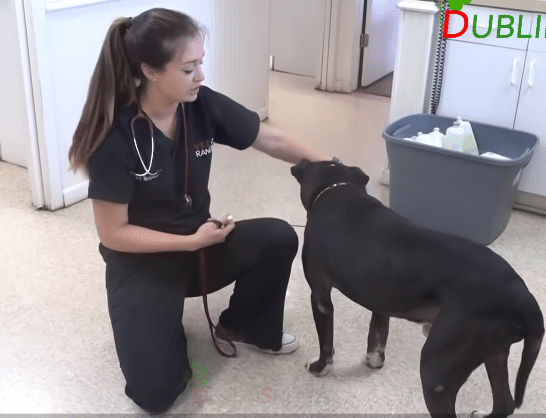
Helping a Stray Dog Responsibly
Shadow’s story may inspire people to help animals they encounter outdoors, but safety should remain a priority.
An unfamiliar dog may be frightened, injured, or uncomfortable. Even a friendly animal can react defensively when approached too quickly.
If you discover a dog with a major medical problem, contact an established rescue organization, animal control service, or veterinary clinic whenever possible.
Avoid attempting to remove masses, embedded objects, or tightly attached materials yourself.
Professional evaluation protects both the animal and the person trying to help.
If the dog can be transported safely, a veterinary clinic can scan for a microchip and assess immediate medical needs.
Responsible rescue begins with compassion, but it succeeds through appropriate action.
A New Chapter for Shadow
According to the rescue account, Shadow eventually became a stronger and much more active dog surrounded by people committed to his care.
His transformation involved several important elements: timely rescue, professional diagnosis, complex surgery, nutritional rehabilitation, treatment for additional health concerns, and gradual physical recovery.
There was no single magical solution.
Instead, many people made responsible decisions at the right moments.
Shadow’s willingness to interact with rescuers on the day he was found was only the first small sign of what his personality might become once his physical burdens were addressed.
Given time and care, that personality had room to shine.
Summary
Shadow was found as an extremely thin stray carrying an unusually large mass on his right front leg. According to the rescue account, the growth weighed more than 11 pounds and significantly affected his ability to move comfortably.
Veterinary examinations also reportedly identified heartworm disease, adding another challenge to an already complicated medical situation. Although removing the affected leg was initially considered, surgeons ultimately attempted to preserve it while removing the mass.
After a lengthy operation, the veterinary team reportedly succeeded. Laboratory analysis later identified the tumor as benign, while Shadow continued receiving treatment, nutrition, postoperative monitoring, and gradual rehabilitation.
Over the following weeks, his strength and mobility improved. He gained healthier body condition, became more active, and returned to everyday activities such as walking and playing.
Shadow’s journey highlights the importance of professional veterinary diagnosis, responsible heartworm prevention, balanced nutrition, rehabilitation, and patient follow-up care.
Most of all, his story shows what can happen when someone notices a struggling animal and chooses an appropriate way to help. One careful rescue did not instantly solve every problem Shadow faced, but it opened the door to veterinary care, recovery, and a future in which every step could finally feel a little lighter.